Can Marine Plywood Be Used for Wall Panelling?
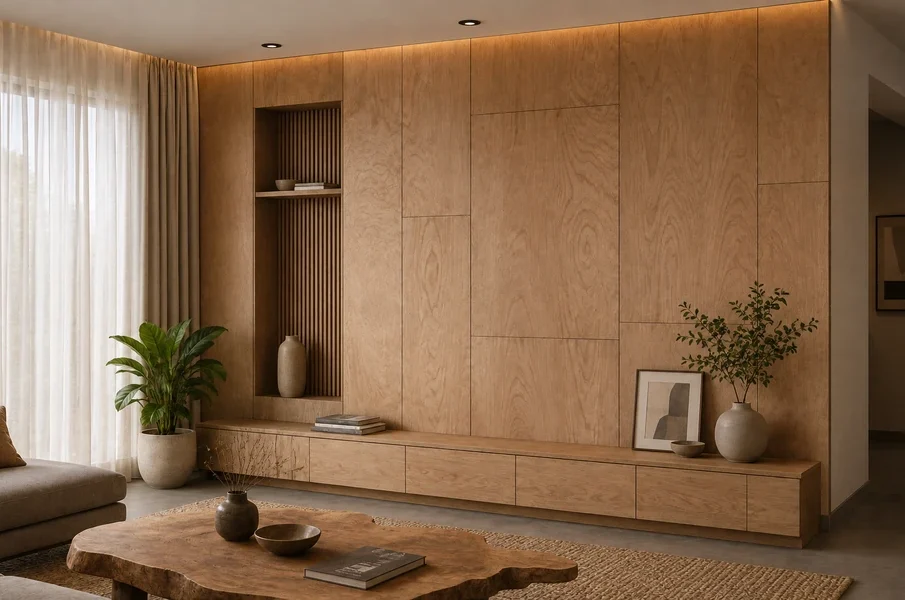
The question of whether it is possible to use marine plywood as wall panelling has arisen. Although marine plywood is known for its use in applications requiring water resistance, its use is not limited to applications requiring the use of wood in water, and its properties can be beneficial in wall panelling applications where the installation environment, design specification, and finishing system justify its use.
It is crucial to evaluate the use of marine plywood in the location where the wall to be constructed will be placed. The panels used in areas with high humidity face different challenges from those used in dry rooms. Bathrooms, kitchens, utility spaces, and some semi-open areas are exposed to humidity, condensation, and splashes.
Thanks to its water-resistant properties, marine plywood can be used in such applications. However, the wall itself should not be exposed to constant water. This means that the surfaces as well as joints of the wall should be protected from moisture.
Consider the Place of Installation
It is important to understand that not all walls need the use of marine plywood. For example, interior walls in bedrooms, living rooms, and studies can be installed from materials that do not require marine plywood. Making use of materials suitable for the given environment makes it possible to reach a balance between the technical characteristics of the material and the project cost.
Examine the Core Construction
The plywood and wall quality depend on the design. Before making a purchase, check along the edges of the plywood for any large gaps, loose layers, or visible separation. By seeking out a consistent core, the process of making the panels will become easier.
Use Appropriate Thickness
The thickness of plywood represents a variable that must be factored in when determining the size of the plywood panels, their supporting frame, design, and finish. As an example, larger panels will require different specifications from small decorative pieces.
Thickness should also be considered when looking at how to join the panels. Finding the ideal solution should help in minimising movement while providing a uniform finished appearance.
Assess Surface Quality
As wall panels are highly visible, surface quality has a major impact on the final appearance. People should, therefore, seek to make sure that the panels are free from excessive cracks, rough areas, deep defects, or uneven patches before installing them.
Remember that proper surface quality allows for the use of laminates, paints, textures, and other decorative treatments. What people need to do is keep their finishing process in mind before acquiring plywood.
Ensure that Edges and Joints are Properly Treated
Even plywood that is supposed to resist moisture can be affected by it when it gets into the wood through unprotected areas. Plywood panels need to be cut around electrical fittings, corners of walls, sockets, windows, and other architectural parts.
As such, the cut edges, surface and joints need to be properly treated.
Be Mindful of Installation Requirements
Before the installation procedure of marine plywood panels, the wall that will support them should be well prepared. If there are any irregularities or moisture on the surface, complications may arise, although the plywood can resist moisture without any problems.
Correct measurements and suitable fixing methods are important. The panels must be fixed in the correct places while leaving space for movement and for a finish.
Select the Appropriate Finish for Your Interior
Marine plywood may be used as a foundation for some types of wall panelling. Natural wood veneer can provide a simple,y natural look, while laminates can add colour and texture, or create patterns. If a smooth surface is required, paint can be used.
The finish must match the overall style of the room, its furniture, flooring, light, etc. Thus, in decorative interiors, the plywood should be characterised by its coating and compatibility in terms of finishing.
Is It Always Necessary to Use Marine Plywood for Every Wall?
It is worth mentioning that marine plywood should not be chosen automatically for each and every wall panelling project. Its extra qualities in resisting moisture may be of use only in installation circumstances requiring it.
In a case with dry interior walls, water-resistant plywood can be used instead, while marine plywood can be considered a proper material with the help of proper installation.
Choose Based on Application
The type of plywood to be used should be chosen based on the peculiarities of the existing wall. The conditions of use such as humidity, possible water exposure, size of the panels, ways of fixing, type of finishing, etc. must be taken into account.
For instance, Royale Touche marine plywood should be used for wall paneling in case there is a need for moisture resistance, while the choice will depend on the conditions of construction and use of marine plywood.
Conclusion
Marine plywood may be suitable for wall panelling if the additional properties of moisture resistance are required. However, the appropriateness of marine plywood depends on the exact location of the wall, thickness of the plywood, type of core construction, conditions of the surface, finishing, and installation method used. In the case of dry interiors, another appropriate type of plywood can be used instead, while a more suitable type is required in case there are many moist areas.